

If you’re diving into The Elder Scrolls universe or just wondering how many Skyrim games actually exist, you’re in for a wild ride. Between the base game, special editions, VR versions, and spin-offs, Bethesda has managed to release Skyrim across almost every platform imaginable, sometimes multiple times. This guide breaks down all Skyrim games in order, from the original 2011 release to what’s coming next. Whether you’re playing on PC, PlayStation, Xbox, Nintendo Switch, or even VR headsets, we’ll map out every version so you know exactly what you’re getting and when it launched.
Key Takeaways
- All Skyrim games in order begin with the 2011 original release across PS3, Xbox 360, and PC, followed by three major expansions (Dawnguard, Hearthfire, Dragonborn) released throughout 2012.
- The Skyrim Special Edition (2016) modernized the game for PS4, Xbox One, and PC with enhanced graphics, faster loading times, and an overhauled modding ecosystem for consoles.
- Bethesda expanded Skyrim beyond traditional consoles with VR editions for PlayStation VR (2017) and SteamVR (2017), plus The Elder Scrolls: Blades as a mobile and Nintendo Switch spin-off (2019).
- The Anniversary Edition (November 2021) bundled over 500 pieces of community-created content from the Nexus modding community, providing the most complete official experience available today.
- Expect continued Creation Club updates and future platform ports for Skyrim, while The Elder Scrolls VI remains in early development with no official release date expected before 2027-2028.
- Skyrim’s durability across fifteen years and multiple platform releases demonstrates its cultural significance as a gaming phenomenon, with the active modding community continuously evolving the experience.
The Elder Scrolls Series Overview
The Elder Scrolls franchise is one of gaming’s most iconic RPG series, and Skyrim is undoubtedly the crown jewel. But it didn’t come out of nowhere, it’s the fifth main entry in a series that stretches back to 1994.
Here’s the core lineup:
- The Elder Scrolls: Arena (1994) – The original that started it all on PC.
- The Elder Scrolls II: Daggerfall (1996) – Massive step forward, basically defined open-world fantasy RPGs.
- The Elder Scrolls Adventures: Redguard (1998) – A spin-off action RPG.
- The Elder Scrolls Legends: Battlespire (1997) – Another spin-off, less talked about.
- The Elder Scrolls III: Morrowind (2002) – PS2, Xbox, PC. Established the modern formula.
- The Elder Scrolls IV: Oblivion (2006) – PS3, Xbox 360, PC. Peak-era action-RPG.
- The Elder Scrolls V: Skyrim (2011) – Everything that followed.
Skyrim’s release in 2011 was a watershed moment for gaming. It landed on PS3, Xbox 360, and PC simultaneously, and it’s never stopped being relevant. The game sold over 30 million copies across all platforms, making it one of the best-selling games ever. That’s why Bethesda keeps re-releasing it, players keep buying it. Understanding Skyrim’s place in the series helps explain why it’s gotten so many versions and why the community is still actively modding and playing it fifteen years later.
The Elder Scrolls V: Skyrim – The Main Game
Original Release and Platforms
The Elder Scrolls V: Skyrim launched on November 11, 2011, across three platforms simultaneously: PlayStation 3, Xbox 360, and PC. This was a massive deal at the time, simultaneous multiplatform releases weren’t as common as they are today, and the scale of Skyrim justified the effort.
The game was built on the Creation Engine, a significantly upgraded version of the engine used in Oblivion. It features 305 hours of recorded dialogue, a handcrafted world containing thousands of locations, and a dynamic quest system that was revolutionary for its time. On the technical side, the PC version supported modding from day one through the Creation Kit, which essentially handed the community the tools to extend the game indefinitely.
Performance-wise, the 2011 version had its quirks. PS3 and Xbox 360 ran at 1080p on PS3 and 720p on Xbox 360 at 30 FPS, with some serious save-file degradation on PS3 after extended playtime (a notorious issue among console players). The PC version had no such constraints and could scale up significantly depending on hardware.
Expansions and DLC Content
Bethesda released three major expansions for Skyrim, each adding substantial content:
Dawnguard (June 26, 2012 – Xbox 360 first, then PS3 and PC)
- Added vampire-focused quests and the Dawnguard faction
- Introduced the crossbow weapon type
- Brought back flying dragons as a significant threat
- File size: approximately 2 GB
Dragonborn (December 4, 2012 – Xbox 360 first)
- Returned to Morrowind’s Solstheim region
- Introduced the Thu’um shout system expansion
- Added new dragon priest encounters
- Expanded character customization with new races
- File size: approximately 1.6 GB
Hearthfire (September 4, 2012 on Xbox 360)
- Smaller expansion focused on player housing
- Let you build your own homes from scratch
- Added family systems and settlement management
- File size: approximately 400 MB
Beyond the major expansions, Bethesda released dozens of smaller DLC packs ranging from $1-3 each. These included cosmetic items, weapons, armor sets, and map expansions. The total DLC library for the original game reached over 50 items before the Anniversary Edition consolidated everything.
Skyrim Spin-Offs and Special Editions
Skyrim Special Edition
The Skyrim Special Edition launched on October 28, 2016, across PlayStation 4, Xbox One, and PC. This was the upgraded version built on the updated Creation Engine with improved graphics, processing, and stability for eighth-generation consoles.
What changed:
- Graphics overhaul – Enhanced draw distances, better shadow quality, improved texture resolution (up to 4K on certain assets).
- Stability improvements – The notorious PS3 save-file bug was gone. Loading times were significantly faster on all platforms.
- Modding ecosystem – The mod toolset was completely rebuilt. PlayStation 4 modding was introduced (though with restrictions), and Xbox One got full mod support matching PC.
- Cross-platform parity – All DLC and expansions were included in the base game.
- Performance targets – 1080p/60fps on PS4 and Xbox One in performance mode, with fidelity modes pushing higher resolution at lower framerates.
This version essentially became the definitive way to play Skyrim on console for most players. Sales figures aren’t officially separated, but the Special Edition has likely sold 10+ million copies. It’s still the base version listed on PlayStation and Xbox stores.
Note: The Special Edition is NOT the same as the Anniversary Edition (covered below). The SE is the enhanced base game: the Anniversary Edition adds a content layer on top.
Skyrim VR Editions
Bethesda released two VR versions of Skyrim, bringing the full game to virtual reality:
PlayStation VR (November 17, 2017)
- Full game converted to VR with motion controls
- Runs at 1080p/90fps on PS4 Pro, 720p/90fps on standard PS4
- Uses PlayStation Move controllers or standard controller support
- Motion sickness mitigation options included
- Performance optimization was significant, not every NPC or dungeon made the cut to maintain frame rates
SteamVR (Valve Index, HTC Vive, Oculus Rift) (April 3, 2017 – technically launched before PSVR)
- Full game on PC with VR headset support
- Highest visual fidelity available due to PC hardware variance
- Motion controls fully supported
- Considerably more demanding: requires minimum RTX 1080 or RTX 2080 Super for stable 90fps
VR Skyrim is genuinely transformative, actually standing in Whiterun’s marketplace or looking down at a dragon from a tower changes how you experience the world. But, it’s a niche product due to VR headset costs and the performance demands on PC. Both versions maintain the full questline and essential content, though some graphical details are simplified for performance.
The Elder Scrolls: Blades
Blades launched on March 27, 2019, for Nintendo Switch, then expanded to iOS and Android in April 2019. It’s technically a Skyrim spin-off, though it’s its own game rather than a re-release.
Blades is a first-person dungeon crawler RPG, much smaller in scope than Skyrim but built using the same art style and lore. It plays like a mobile/Switch-optimized Elder Scrolls experience with turn-based combat simplified for touchscreen or handheld controller input.
Key differences from Skyrim:
- Scope – Dozens of hours instead of 100+. Story-driven but linear.
- Gameplay – First-person exploration and combat, but streamlined for mobile/handheld play.
- Monetization – Free-to-play on mobile with optional cosmetic purchases and battle pass. Full paid version on Switch ($20).
- Platform availability – Nintendo Switch, iOS (iPad/iPhone), Android. No PC or console ports.
Blades didn’t reach Skyrim’s cultural impact, but it serves a niche: Elder Scrolls fans wanting portable, bite-sized content. Community reception was mixed due to the free-to-play monetization on mobile, though it’s improved since launch.
Skyrim Remastered and Anniversary Edition
Anniversary Edition Features and Content
The Anniversary Edition released on November 11, 2021, exactly ten years after the original game. It’s not a new game, it’s the Special Edition with an added content layer released through an “Anniversary Upgrade” ($19.99) or as a standalone bundle ($59.99 for new players).
What makes it different:
Content additions:
- Over 500 pieces of new content curated from the most popular mods on Nexus and other modding communities.
- New quests, dungeons, weapons, armor sets, spells, and items created in partnership with modders.
- Examples include the “Cause” questline (new Daedric invasion), “Ghosts of the Tribunal” (Morrowind-flavored content), and new player homes like Hendersheim and Gallows Hall.
- Fishing minigame and fishing-related quests.
- Survival mode overhaul with hunger, fatigue, and disease mechanics.
- Saints & Seducers questline and equipment.
Cross-platform rollout:
- November 11, 2021 on PC, PlayStation, and Xbox simultaneously.
- Performance targets remained the same as Special Edition (1080p/60fps target on consoles).
Important note: Anniversary Edition doesn’t break compatibility with existing Special Edition mods, but the 500+ Creation Club items do take up significant space in your load order. Console players especially felt the impact, the Anniversary Edition pushed the limits of what PS4 and Xbox One could handle in terms of simultaneous active content.
Critical reception: Gamers had mixed feelings. Some loved the curated content and official modding integration. Others felt the $20 upgrade was expensive for content that was already freely available as mods on PC. There’s also ongoing debate about Creation Club items being ported from community mods, proper credit was given, but the commodification of free community work rubbed some players the wrong way.
As of March 2026, the Anniversary Edition is the current “official” version of Skyrim on all platforms except Nintendo Switch (which still runs the base Special Edition, no Anniversary Update on Switch).
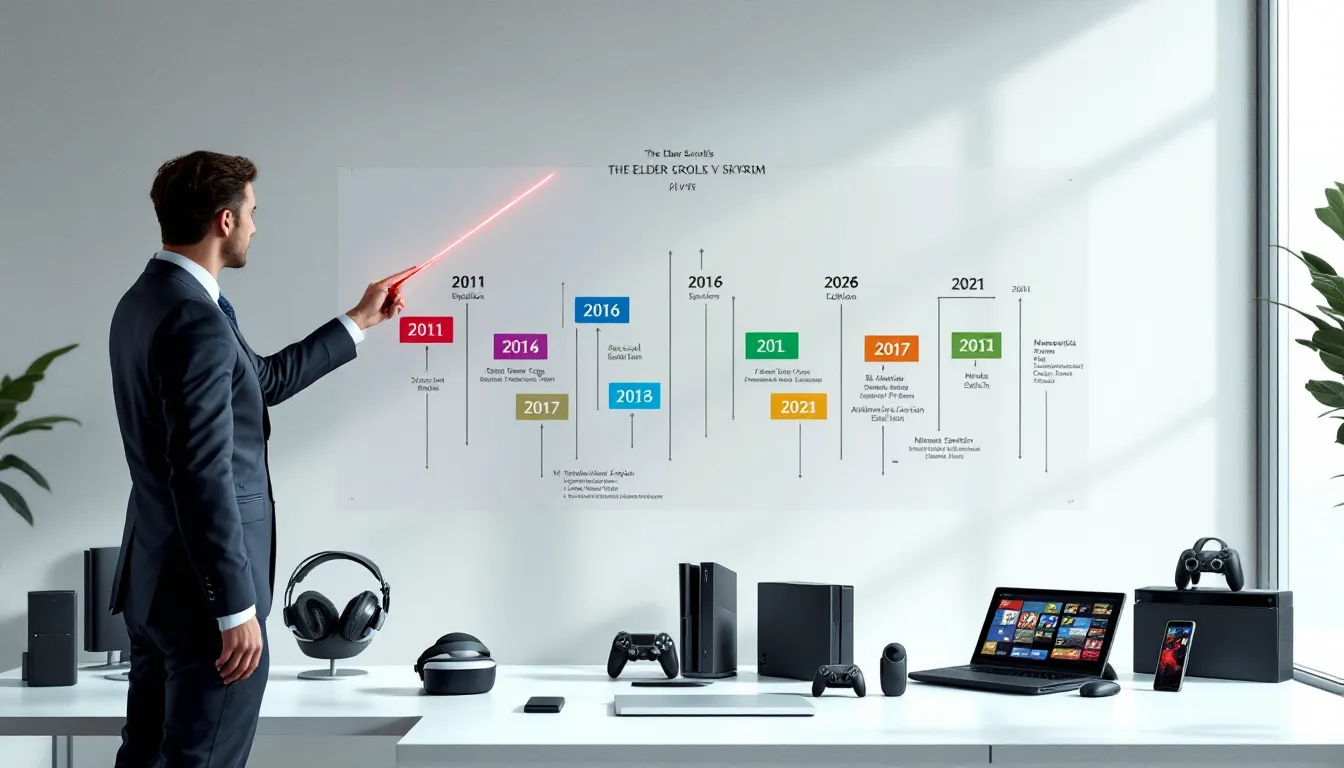
Chronological Order of All Skyrim Releases
Here’s every Skyrim release in chronological order:
2011:
- November 11: The Elder Scrolls V: Skyrim (PS3, Xbox 360, PC)
2012:
- June 26: Dawnguard (Xbox 360 exclusive, then PS3/PC)
- September 4: Hearthfire (Xbox 360, then other platforms)
- December 4: Dragonborn (Xbox 360, then other platforms)
- Throughout the year: 50+ Creation Club items and cosmetic DLC
2016:
- October 28: Skyrim Special Edition (PS4, Xbox One, PC)
2017:
- April 3: Skyrim VR (SteamVR – Valve Index, HTC Vive, Oculus)
- November 17: Skyrim VR (PlayStation VR)
2019:
- March 27: The Elder Scrolls: Blades (Nintendo Switch)
- April 2019: Blades (iOS/Android mobile)
2021:
- November 11: Skyrim Anniversary Edition (Anniversary Upgrade for existing Special Edition owners: new purchase bundle for all platforms except Switch)
2023-2024:
- November 11, 2023: Anniversary Edition for Nintendo Switch (five years after the console launched, Switch finally got the update)
- Throughout: Ongoing Creation Club updates for Anniversary Edition
This timeline shows something interesting: Bethesda didn’t just release Skyrim once and call it done. They’ve re-released it six times across different platforms and hardware generations. That’s either evidence of the game’s massive appeal or Bethesda’s canny business sense, probably both.
Each release has found an audience. The original captured console and PC gamers in 2011. The Special Edition brought it to eighth-gen consoles. VR versions tapped into the emerging VR gaming market. Blades served mobile and handheld players. The Anniversary Edition pulled in players who wanted curated mod content without diving into Nexus modding themselves.
Future Skyrim Projects and What’s Coming Next
As of March 2026, there’s no official announcement of a Skyrim 2 or direct sequel. Instead, Bethesda’s focus is on The Elder Scrolls VI, which is still in early development and isn’t expected until 2027 at the earliest, likely 2028 or beyond.
What we know about TES VI:
- Todd Howard confirmed it’s in active development but prioritized below Starfield’s continued support.
- The engine is supposedly a significant upgrade from Creation, built partially in-house and partially using updated middleware.
- No official release date, setting, or plot details have been announced.
- Community speculation points to High Rock or Hammerfell as likely settings based on lore and previous hints.
For Skyrim specifically, expect:
Continued Creation Club updates – Bethesda will likely keep releasing small cosmetic and questline content bundles. These have been consistent every few months since Anniversary Edition.
More platform ports – Bethesda has shown willingness to bring Skyrim to new hardware. If a new handheld or VR platform launches, Skyrim will probably appear there eventually. Seriously, at this point it’s a given.
Modding community thriving – The real future of Skyrim lives in mods. Recent RPG guides on major gaming sites continue to feature fan-created content like Skybrim (combining Oblivion and Skyrim), completely new questlines, and gameplay overhauls. The community essentially creates “Skyrim 2” through mods year after year.
Enhanced ports for next-gen consoles – If PlayStation 6 or Xbox Series X2 launch before TES VI, expect a “Skyrim Ultimate Edition” or similar branding to resurface. Bethesda loves releasing Skyrim on new hardware, and it’s a safe revenue play.
The honest take: Skyrim has become gaming’s equivalent of The Rolling Stones. It keeps touring (getting re-released) because people keep buying tickets. That might sound cynical, but the game legitimately holds up. Comprehensive game reviews on major platforms still rank Skyrim in their “best RPGs ever” lists alongside modern releases like Baldur’s Gate 3.
Don’t expect a traditional “Skyrim 2” anytime soon. Tier lists and character build guides from the community will likely keep evolving as new creation club content and mods push the game in unexpected directions. In 2026, Skyrim remains the living, breathing foundation of The Elder Scrolls universe, not because it’s the latest game, but because the player base won’t let it die.
Conclusion
From the original 2011 release to the Anniversary Edition update in 2021 and beyond, Skyrim has become one of gaming’s most durable franchises. Across consoles, PC, VR headsets, and mobile devices, there’s literally a version of Skyrim built for whatever platform you own.
The complete timeline breaks down like this: The original PS3/Xbox 360/PC version launched the phenomenon. The Special Edition (2016) upgraded it for modern console hardware. VR versions (2017) let you step into Tamriel. Blades (2019) brought Elder Scrolls to mobile. And the Anniversary Edition (2021) bundled five years of community-created content into one package.
If you’re planning to jump into Skyrim for the first time or return to it, the Anniversary Edition on your preferred platform is the most complete experience available. For PC players specifically, the modding community continues to evolve the game in ways official releases never could. For next-gen console players, you’re looking at Special Edition or Anniversary Edition depending on your platform and what content you want.
Eventually, all Skyrim games in order tell the story of a game that transcended its 2011 release to become a permanent fixture in gaming culture. Whether you’re speedrunning, roleplaying, modding, or just exploring because you missed a quest in 2015, Skyrim still delivers. That’s why fifteen years later, it’s still being released on new platforms. That’s not Bethesda squeezing a franchise dry, it’s evidence that Skyrim fundamentally captured something special that keeps calling players back.