
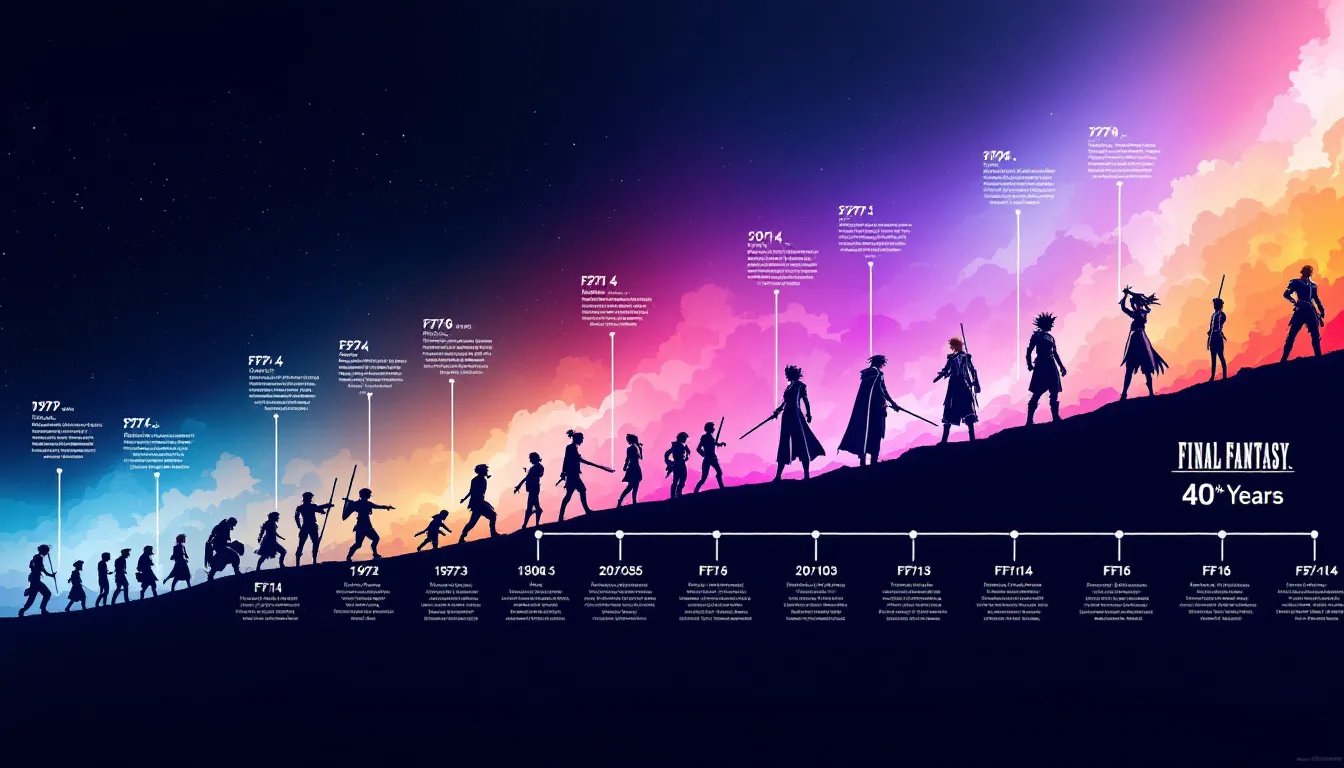
If you’ve ever scrolled through a gaming store and wondered where to even start with Final Fantasy, you’re not alone. With over 40 mainline and spin-off titles spanning nearly four decades, figuring out all final fantasy games in order can feel overwhelming. The Final Fantasy franchise has reinvented itself multiple times, from sprite-based adventures on the NES to open-world epics on modern consoles, making it one of gaming’s most diverse and ambitious franchises. This guide breaks down the complete list of all final fantasy games, including remakes, remasters, and spin-offs, so you can navigate the series with confidence whether you’re a longtime fan or jumping in for the first time.
Key Takeaways
- Final Fantasy games in order are best experienced by release date rather than narrative timeline, as each numbered entry was designed as a standalone experience with its own world and story.
- The franchise has evolved dramatically from sprite-based NES games to open-world epics and MMOs, fundamentally changing combat systems, art styles, and mechanics with each mainline numbered entry.
- For new players, starting with Final Fantasy IV, VI, or XVI provides strong entry points depending on whether you prefer classic experiences or modern action gameplay.
- Remakes and remasters like the Pixel Remaster series (FF1-6) and Final Fantasy VII Remake significantly modernize the original games, making them the recommended versions for new players unfamiliar with late-90s graphics and controls.
- A curated ‘greatest hits’ experience of 5-6 titles across different eras—such as FF4, FF6, FF7, FF10, FF14, and FF16—gives players the full picture of the franchise’s evolution without requiring 500+ hours of gameplay.
- Understanding the distinction between direct sequels (like FF10-2 and the FF13 trilogy), spin-offs (Crisis Core, Kingdom Hearts), and MMOs (FF11, FF14) is essential for building a comprehensive final fantasy game list that fits your interests.
Understanding Final Fantasy Release Order vs. Narrative Timeline
Before diving into the full breakdown, it’s important to understand that Final Fantasy games exist in two different organizational structures: release order and narrative timeline. Most games in the series are standalone with their own worlds, characters, and stories, which means the narrative timeline isn’t linear in the way something like Kingdom Hearts is. Release order is straightforward, it’s when games actually hit the market. The narrative timeline, but, applies mainly to direct sequels and interconnected universes.
For most players, release order is the best way to experience the franchise because each numbered entry (Final Fantasy I, II, III, and so on) was designed independently. The developers didn’t assume players had completed the previous game. That said, some remakes, remasters, and spin-offs directly tie into existing stories. Crisis Core: Final Fantasy VII, for example, is a prequel that deepens the narrative of FF7, so playing it after FF7 proper enhances the experience rather than replaces it. Understanding this distinction prevents confusion when you’re trying to build your Final Fantasy in order playthrough.
The Mainline Series: Games I Through XVI
The numbered Final Fantasy games represent the core identity of the franchise. Across sixteen main entries (with more potentially on the horizon), each numbered installment has redefined what a Final Fantasy game can be. They range from turn-based tactical combat to real-time action systems, from medieval fantasy to cyberpunk dystopias.
Final Fantasy I Through III: The Classic Era
Final Fantasy I (1987, NES) kicked off the entire franchise and established the series’ DNA: a party-based RPG with job classes, turn-based combat, and an epic quest to save the world. The game’s job system allowed players to customize their four-person party with classes like Warrior, Thief, Monk, and Black Mage, a template that influenced RPG design for decades. FF1 is available on virtually every platform imaginable: NES, PlayStation, PlayStation Network, iOS, Android, Switch, and PC. The original is 8-bit, but you can experience the Updated Pixel Remaster (2021) on Switch, PS4, and PC, which modernizes the visuals while keeping the classic gameplay intact.
Final Fantasy II (1988) introduced a “growth through use” leveling system instead of traditional experience points, along with a keyword-based dialogue system. It’s significantly harder than FF1 and experiment in narrative structure, focusing on a group of resistance fighters instead of legendary heroes chosen by destiny. Final Fantasy III (1990) returned to job classes and added the Onion Knight job, which could eventually master all classes. FF3 was never officially released outside Japan until 2006, making it the last classic-era game most Western players could access.
These three games are available on Switch, PlayStation (via PlayStation Network), and PC through modern ports and remasters. The Pixel Remasters are the recommended versions for new players who want updated graphics without losing the 1980s charm.
Final Fantasy IV Through VI: The Golden Age
Final Fantasy IV (1991, SNES) marked the franchise’s leap into 32-bit territory and introduced many elements fans still associate with classic FF: the ATB (Active Time Battle) system created by Hiroyuki Ito, character-driven narratives, and a proper story that rivaled console JRPGs for cinematic scope. FF4 featured Cecil, a Dark Knight turned Paladin, and an ensemble cast with distinct personalities. The game popularized the idea that FF protagonists weren’t silent avatars but actual characters with agency and conflict.
Final Fantasy V (1992) refined the job system into something more elaborate, offering 22 different jobs and deep character customization. It’s beloved by hardcore fans for its combat system but often overlooked by newcomers due to its lighter, more whimsical tone compared to FF4’s darker narrative. The story follows Bartz, a drifter with a Chocobo, on a quest to save the world from an ancient evil.
Final Fantasy VI (1994) is frequently cited as one of gaming’s greatest RPGs ever made. It featured no single protagonist, instead, an ensemble cast of fourteen playable characters, each with distinct stories and abilities. FF6’s world is destroyed halfway through the narrative, forcing players to rebuild and navigate a post-apocalyptic setting. The game is remembered for its incredible soundtrack, complex character development, and willingness to kill off major characters (which was shocking for gaming at the time). Kefka, the villain, remains one of the most beloved antagonists in gaming history for his sadistic, theatrical villainy.
All three of these games are available on Switch, PlayStation, PC, and mobile via modern remasters. The SNES originals are available via Switch Online subscription, while the Final Fantasy Pixel Remaster series provides updated versions on Switch, PS4, and PC.
Final Fantasy VII Through X: The PlayStation Revolution
Final Fantasy VII (1997, PlayStation) was the franchise’s biggest turning point. It shifted from Mode 7-style isometric perspective to full 3D, moving from the SNES to PlayStation. FF7 introduced Cloud Strife, one of gaming’s most iconic characters, alongside Sephiroth, an antagonist who became arguably the most recognizable villain in gaming. The game’s story, involving a mega-corporation harvesting the planet’s lifeforce, an elite paramilitary unit, and an ancient alien threat, opened Final Fantasy to audiences who’d never touched an RPG before.
FF7’s cultural impact cannot be overstated. It made JRPGs mainstream in the West. Since 2020, Square Enix has been remaking FF7 in multiple parts: Final Fantasy VII Remake (PS4/PS5, 2020) reimagines the Midgar section with modern graphics and real-time combat, while Final Fantasy VII Rebirth (PS5, 2024) continues the story. These remakes expand and reinterpret the original, but the 1997 original is still the definitive version for understanding the complete story.
Final Fantasy VIII (1999) followed with a controversial junction system for magic and a complex narrative involving time travel, alternate timelines, and a war between rival military academies. Its protagonist, Squall Leonhart, was intentionally less heroic and more emotionally withdrawn than Cloud. FF8 has a passionate but smaller fanbase compared to FF7: many players find it harder to engage with due to its convoluted story and the junction system’s initial learning curve.
Final Fantasy IX (2000) was a deliberate return to the franchise’s roots, embracing medieval fantasy over the sci-fi aesthetic of FF7 and FF8. It starred Zidane, a thief, and offered a colorful, character-driven narrative with subtle meta-commentary about the nature of video games themselves. FF9 is considered the spiritual successor to FF6 in many ways, and it marked the final mainline FF release on the original PlayStation.
Final Fantasy X (2001, PS2) introduced voice acting and completely revamped the combat system with a turn-based grid that showed the order of actions. It was the first mainline FF with a direct sequel: Final Fantasy X-2 (2003), which starred Yuna as the main protagonist and featured a job system reminiscent of FF3 and FF5. FF10 is set in the water-covered world of Spira and deals with themes of mortality, sacrifice, and religion. It’s available on PS2, PS3, PS4, PS5, Xbox, and Switch.
These four games represent the PlayStation era and are widely available across modern platforms. FF7 Remake/Rebirth provide modern takes, while the originals are available on PlayStation Network and can be emulated or played on original hardware.
Final Fantasy XI Through XVI: Modern Gaming and Beyond
Final Fantasy XI (2002) was a pivotal release: it became an MMORPG, breaking the mold of the numbered series being single-player experiences. FF11 is still active today as one of gaming’s longest-running MMOs, with a dedicated community and continuous updates. It’s free-to-play on PC and PlayStation 2/4, though expansions require subscription or purchase.
Final Fantasy XII (2006, PS2) introduced a large open world with a political story more grounded than previous entries, featuring Vaan as the protagonist and Balthier as the true main character (a narrative twist that deconstructed FF tropes). The International Zodiac Job System version (PS2, PS4, Xbox One, Nintendo Switch, PC) added job classes and updated mechanics, making it the definitive way to experience FF12. The combat uses a real-time system called the Gambits, where players program AI behaviors for party members.
Final Fantasy XIII (2009, PS3/Xbox 360) was the franchise’s most linear game, a straight-line narrative with combat encounters but minimal exploration. It’s divisive among fans: some appreciate its focus on story and character development, while others feel it was too restrictive. Final Fantasy XIII-2 (2011) and Lightning Returns: Final Fantasy XIII (2013) are direct sequels that continue the Lightning saga. The entire trilogy is available on PS3, Xbox 360, and modern platforms via ports.
Final Fantasy XIV (2010, then A Realm Reborn in 2013, PS3/PS4/PC) is an MMORPG that, after a catastrophic original launch, was completely rebuilt as “A Realm Reborn.” It’s now one of gaming’s most successful MMOs, rivaling World of Warcraft in recent years. FF14 features engaging storytelling unusual for MMOs, with expansions like Heavensward, Stormblood, Shadowbringers (widely praised as FF14’s peak), and Endwalker. The latest expansion, Dawntrail (2023), introduced new jobs and storylines. FF14 requires a subscription on all platforms but has a generous free trial.
Final Fantasy XV (2016, PS4/Xbox One) was in development for ten years (originally as Final Fantasy Versus XIII). It featured an open world, real-time combat, and a road-trip narrative following Prince Noctis and his friends. Multiple expansions, DLCs, and the anime Kingsglaive: Final Fantasy XV expanded the world. FF15 is more action-oriented than previous entries, though updates and patches significantly altered combat balance throughout its lifecycle.
Final Fantasy XVI (2023, PS5) is the latest mainline entry, developed as a PlayStation 5 exclusive (with a planned PC release). It features a mature, dark fantasy narrative inspired by Game of Thrones, full real-time action combat, and summoned creatures called Eikon that serve as reality-warping weapons. FF16 marks a significant tonal shift, it’s grittier and less “anime” than previous entries. Unlike FF15’s open world, FF16 features linear levels with exploration between action sequences. Platform availability is currently PS5-exclusive, with a PC version expected in 2025.
Spin-Offs and Side Games: Crisis Core, Kingdom Hearts, and More
Beyond the numbered series, Final Fantasy has spawned dozens of spin-offs ranging from action games to rhythm games to phone applications. Understanding how these fit into the larger franchise is important for building your complete Final Fantasy in order experience.
Direct Sequels and Compilations
The Compilation of Final Fantasy VII includes several games that expand the FF7 world. Crisis Core: Final Fantasy VII (2007, PSP: 2023 Remaster on PS4/PS5/Xbox/Switch) is a prequel following Zack Fair, a soldier who became Cloud’s best friend. Crisis Core’s story directly impacts how you understand FF7’s narrative, making it essential context for fans diving deep into that universe. The 2023 Crisis Core Reunion remaster modernized the graphics and updated mechanics while preserving the original narrative.
Dirge of Cerberus: Final Fantasy VII (2006, PS2) was an action shooter featuring Vincent Valentine. It’s one of the less critically acclaimed FF7 spin-offs but exists in the continuity. Final Fantasy VII: Advent Children (2005) was a CGI film that served as FF7’s epilogue and introduced Sephiroth’s remnants and the disease Geostigma, key context for understanding Aerith’s continued role in FF7’s expanded universe.
Other direct sequels include Final Fantasy X-2.5: The Price of Eternity (an audio drama that became a short novella), Final Fantasy Type-0 (2011, PSP: 2015 remaster on PS4/Xbox One), and the Dissidia Final Fantasy series, which are fighting games that pull characters from across the franchise into an interdimensional tournament.
Crossover Titles and Multiplayer Experiences
The Kingdom Hearts franchise, while technically a Disney and Square Enix collaboration, heavily features Final Fantasy characters and worlds. Squall, Cloud, and Aerith all appear in various Kingdom Hearts games. Games like Kingdom Hearts involve intricate Final Fantasy lore that intertwines with the series’ broader narrative. While Kingdom Hearts isn’t strictly Final Fantasy, any comprehensive Final Fantasy timeline discussion must acknowledge its existence.
Dissidia Final Fantasy (2008, PSP: later on PS4 and arcade) is a fighting game featuring FF heroes and villains battling across dimensional rifts. Dissidia 012 Final Fantasy expanded the roster, and Dissidia Final Fantasy NT (2018) became an arcade-based competitive game. These games aren’t essential to understanding FF narrative, but they’re fun ways to see characters from different games interact.
Final Fantasy All The Bravest and Final Fantasy Record Keeper are mobile games that celebrate the franchise’s history by featuring characters and sprites from across all numbered entries. Final Fantasy Brave Exvius is a turn-based mobile RPG featuring an original story with cameos from mainline games. These mobile titles are free-to-play with gacha mechanics and serve as accessible entry points for casual players.
Final Fantasy VII: The First Soldier was a battle royale game on mobile featuring FF7 characters, though it has since shut down. Final Fantasy XV: Pocket Edition brought FF15 to mobile in a chibi-styled adaptation. The stability and longevity of mobile FF titles varies, so they’re less critical to the “main” experience.
Remake and Remaster Releases: How They Fit In
Final Fantasy has a complicated relationship with remakes and remasters. Some are faithful updates of classics, while others (like the FF7 Remake) significantly expand and reinterpret the original game. Understanding where remakes fit in your playthrough matters.
Final Fantasy VII Remake Project
The Final Fantasy VII Remake series deserves its own discussion because it’s not a simple remaster, it’s a full reimagining. The 2020 Remake covers the Midgar section of the original FF7, expanding it from roughly 10 hours of gameplay into a full 40+ hour game with new story elements, redesigned boss encounters, and a modern real-time combat system. Cloud, Aerith, Tifa, and Barret feel like entirely fresh characters even though retaining their essential arc.
Final Fantasy VII Rebirth (2024, PS5 exclusive) continues beyond Midgar, covering the overworld and story beats from the original’s middle chapters but with significant new content and changes. If you’re considering playing FF7, you now have a choice: play the 1997 original for the definitive story experience and historical significance, or jump into the Remake/Rebirth for updated graphics and gameplay with an altered narrative that adds new complexity.
Both approaches are valid. The original is cheaper, shorter, and remains the canonical version for most purposes. The Remakes are more accessible to modern players unfamiliar with late-90s PS1 controls and graphics, but they diverge significantly from the source material, Square Enix has indicated future Remake entries will further deviate from the original, suggesting this is a reimagining rather than a straight adaptation.
Classic Remakes and Updated Versions
The Final Fantasy Pixel Remasters (2021-2022, Switch, PS4, PC) are the most comprehensive classic update. They cover FF1 through FF6 with updated 2D pixel art, rebalanced difficulty, new content like job combinations and a bestiary, and modernized soundtracks. These are now the recommended way for new players to experience the classic era, though the original SNES versions remain available via Nintendo Switch Online if you want the “authentic” experience.
Final Fantasy IV: The Complete Collection (2011, PSP: 2014 PC port) included FF4, FF4: The After Years (a sequel), and Interlude (a connecting story). The After Years is a mobile game sequel that was originally released episodically on phones but is better played via this complete collection.
Final Fantasy X/X-2 HD Remaster (2013, PS3: 2015 PS4/Xbox One port: 2019 Switch/PC ports) updated both games’ visuals and audio. The International Zodiac Job System was later added in Final Fantasy XII: The Zodiac Age (2017), which is widely considered the definitive FF12 version.
Final Fantasy III (2006, Nintendo DS) was the first official English release of the NES original, featuring a full 3D remake. The original 1990 Famicom, and the modern Pixel Remaster is now the recommended version. The DS version, while charming, shows its age compared to the Pixel Remaster.
Remakes and remasters complicate the “list of all final fantasy games in order” question because technically, you now have multiple versions of the same game. But, the rule of thumb is: play the most recent version of each game unless you want the historical experience. The Pixel Remasters are superior to the original NES/SNES versions for new players. FF7 Remake and Rebirth are exceptional games even if they deviate from the original, but the original FF7 remains essential for full context.
Best Order to Play Final Fantasy Games for New Fans
With 40+ games in the franchise, new players often ask: where do I actually start? There’s no single “correct” answer because each mainline game is standalone, but several strategies work depending on your preferences.
Starting with Modern Titles
If you want to jump into Final Fantasy with a modern game, Final Fantasy XVI (PS5, 2023) is an excellent entry point. Its real-time action combat is immediately familiar to players comfortable with games like Devil May Cry or God of War, and its dark fantasy tone means it doesn’t lean on franchise knowledge. FF16 is graphically stunning, narratively grounded, and self-contained. The downside: you’ll miss references to other games, and the older games will feel jarring when you eventually circle back to them.
Final Fantasy XIV: A Realm Reborn (PC, PS4, PS5, Xbox, Free trial available) is another strong modern entry. The free trial covers around 100 hours of story, giving you a complete experience without spending money. FF14’s community is welcoming to new players, and the story, especially in later expansions like Shadowbringers, is genuinely excellent. But, an MMO is a different commitment than single-player games, and FF14’s early story is notoriously slow before picking up momentum.
Final Fantasy VII Remake (PS4/PS5) is tempting as an entry point since it’s recent, beautifully made, and features the most iconic protagonist. But, it’s also part of an incomplete story (only Midgar has been covered so far, with Rebirth continuing but not concluding), and you’ll understand references better having played the original. That said, if you absolutely want modern gameplay with Cloud, the Remake works as a standalone story arc.
Playing Chronologically vs. Release Order
For classic games, release order is genuinely better than release date order because each game was designed to stand alone. Here’s a strong path for experiencing the franchise’s history:
- Final Fantasy IV (PS/Switch/PC), This is the gateway drug. It’s not the first game, but it introduced most modern FF conventions and has the most compelling characters. Many players find FF1-3 dated, so starting with FF4 hooks you on the series before going back to classics.
- Final Fantasy VI (PS/Switch/PC), Considered by many the best classic FF. If you want to experience the “golden age” of SNES-era JRPGs, FF6 is essential. A truly masterful game with incredible presentation for its era.
- Final Fantasy VII (PS/Switch/PC or the Remake on PS4/PS5), The original remains essential for understanding gaming history and the franchise’s cultural significance. The Remake is a worthy alternative if you want modern graphics.
- Final Fantasy VIII or X, Your preference here depends on whether you prefer late-90s experimentation (FF8, which is divisive) or early-2000s refinement (FF10, which has voice acting and more cinematic presentation).
- Final Fantasy XIV (PC/Console, Free trial), Jumping into the MMO once you understand FF’s identity gives you a living world to explore with a genuinely excellent story.
If you want to experience everything, the complete final fantasy order would be: FF1, FF2, FF3, FF4, FF5, FF6, FF7, FF8, FF9, FF10, FF10-2, FF11, FF12, FF13, FF13-2, Lightning Returns, FF14, FF15, FF16, plus spin-offs like Crisis Core. That’s 40+ games and 500+ hours of gameplay. Realistically, most players don’t need to play every single entry.
For time-constrained players, here’s a “greatest hits” list: FF4, FF6, FF7, FF10, FF14 (at least the trial), and FF16. That gives you a solid understanding of the franchise’s evolution across four decades without requiring 500 hours.
Conclusion
The Final Fantasy franchise’s strength lies in its willingness to reinvent itself with each numbered entry. Unlike most long-running series that iterate on a formula, FF has fundamentally changed its combat systems, art styles, narratives, and core mechanics across its sixteen mainline games. This variety is both its greatest asset and its most intimidating barrier for new players.
When approaching all final fantasy games in order, remember that there’s no “canon” order that applies across the entire franchise. Most games exist in separate worlds with their own rules, and the concept of a final fantasy timeline doesn’t apply beyond direct sequels like X-2 or the FF13 trilogy. That freedom means you can start almost anywhere, whether with the challenging action of FF16, the engaging MMO community of FF14, or the historical significance of FF7.
For completionists building a comprehensive final fantasy game list, you’ll be looking at decades of releases across multiple platforms. For casual players just wanting to experience the series’ highlights, strategically choosing 5-6 titles across different eras gives you the full picture of how gaming’s greatest franchise evolved. The series has defined what a JRPG can be, influenced generations of game designers, and continues to push boundaries with each new release. That’s why Final Fantasy remains relevant in 2026, not because of nostalgia, but because the franchise consistently delivers new ideas alongside familiar comfort.