

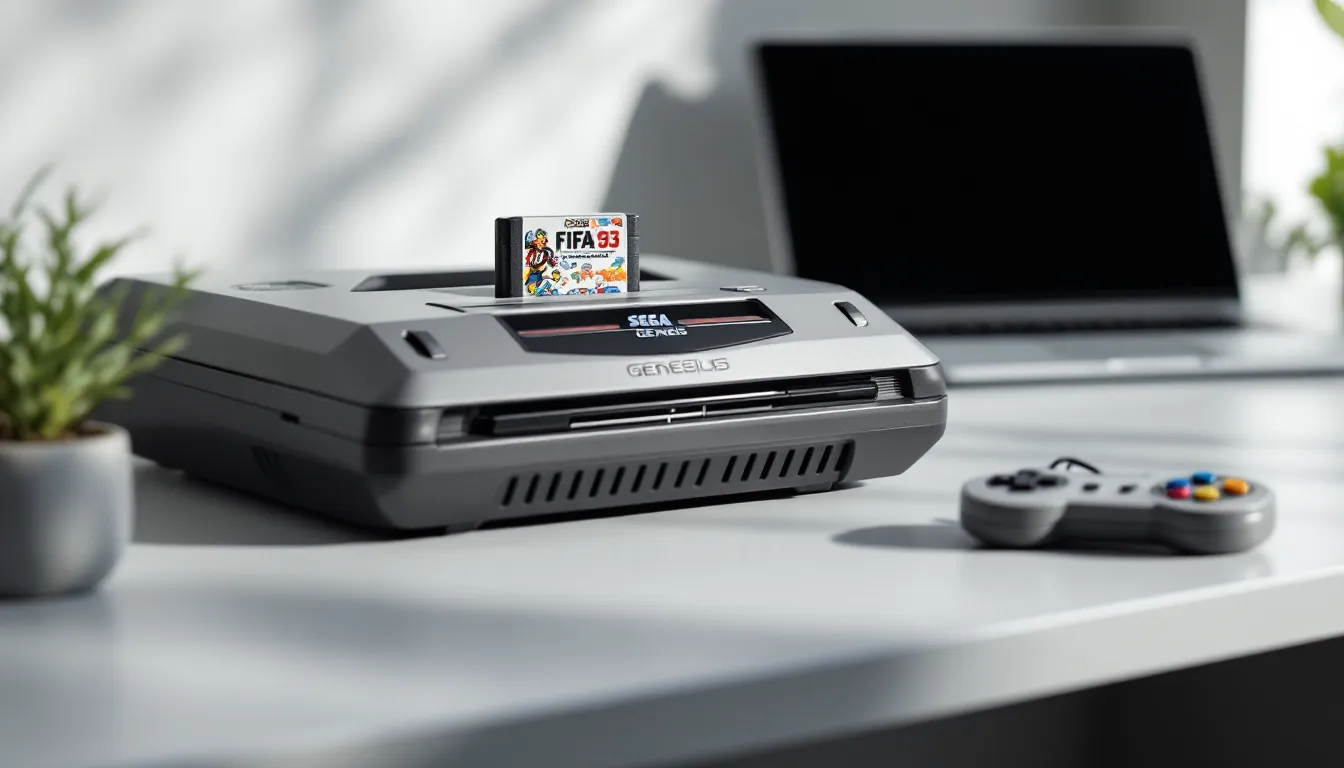
When you think about sports games, FIFA probably comes to mind instantly. But the franchise didn’t start as the juggernaut it became. The original FIFA game launched in 1993, and it was nothing like what gamers experience today. Back then, digital soccer simulation was a novelty, blocky graphics, limited tactics, and a radical idea that you could actually play out full matches on a computer or console. Understanding where the first FIFA game came from, and what it offered, gives you context for everything that followed. Since then, EA Sports has released dozens of FIFA iterations, fundamentally reshaping how we play sports games. This journey from the first FIFA game to modern titles shows you how one decision by a developer led to decades of innovation, competitive play, and cultural impact. Whether you’re curious about gaming history or wondering how many FIFA games exist now, the story starts in 1993.
Key Takeaways
- The first FIFA game launched on June 15, 1993, for Sega Genesis and proved that console gamers wanted authentic sports simulations with official licensing and depth beyond arcade-style alternatives.
- FIFA ’93 introduced innovative gameplay features including squad management, league mode with finances, and tactical formations that separated it from competitors and set the standard for sports gaming.
- The first FIFA game’s success established EA Sports as the dominant force in sports entertainment, inspiring the annual release model and official licensing approach that the entire industry adopted for sports games.
- From turn-based controls to real-time action and online multiplayer, the 35+ FIFA games released since 1993 represent decades of incremental innovation built directly on the first FIFA game’s foundation.
- The legacy of FIFA extends beyond gaming mechanics—it democratized sports entertainment by making authentic, updating competitive experiences accessible on home consoles worldwide, creating shared gaming culture across generations.
What Was The Original FIFA Game?
FIFA’s Launch Year And Platform
The first FIFA game released on June 15, 1993, initially on the Sega Genesis (also known as the Mega Drive). This wasn’t a global simultaneous release, the game rolled out regionally over the following months, reaching other platforms like the SNES and Amiga later that year. The Sega Genesis version became the definitive early experience for most players, though each platform received its own unique optimization.
When you booted up FIFA ’93, you were entering uncharted territory. There were no Ultimate Team modes, no online multiplayer, and no seasonal content. Instead, what you got was a turn-based soccer simulation that let you control teams from 24 countries, with match outcomes determined by both player input and strategic decisions. The game ran at 60 frames per second on Genesis, impressive for its time, but crude compared to modern standards.
The platform limitations shaped everything about the experience. Memory constraints meant detailed player models were impossible. Animation cycles were looped and basic. Yet somehow, that simplicity became part of its charm.
The Developer Behind The First FIFA Title
EA Sports developed FIFA ’93 with a relatively small team compared to today’s massive development studios. The lead programmer and designer worked closely with artists and sound engineers to create something that hadn’t existed before. This wasn’t a massive corporate project with thousands of staff, it was a focused effort to prove that a digital soccer simulation could work on home consoles.
EA Sports’ commitment to the project was strategic. The company saw an opportunity in the sports gaming market and invested the resources to make FIFA happen. That decision would eventually establish EA as the dominant force in sports gaming for the next three decades. The original team’s work became the foundation for what would eventually evolve into one of gaming’s biggest franchises.
Why EA Sports Created The FIFA Franchise
Market Competition In The Early 1990s Gaming Scene
The early 1990s were a chaotic time for sports games. You had arcade-style soccer games, text-based simulations, and a few ambitious attempts at console sports titles, but nothing had truly captured the magic of authentic team-based play on home systems. Games like Sensible Soccer existed and were popular in Europe, but the market was fragmented and hungry for something with real licensing and depth.
EA Sports recognized this gap. The company was already making waves with football and basketball games on the Genesis, establishing itself as a publisher willing to invest in sports entertainment. The soccer market, particularly in North America, was untapped. By securing the official FIFA license, a massive deal at the time, EA gained the right to use real national teams, official tournaments, and authentic branding that competitors couldn’t match.
This licensing was critical. Having the FIFA name, the ability to feature real teams and international tournaments, gave EA an edge that pure gameplay alone couldn’t provide. Gamers wanted authenticity, and EA could deliver it.
The Vision For Digital Soccer Simulation
EA’s vision wasn’t just to make another sports game. They wanted to create a comprehensive soccer simulation that captured the strategic depth of the sport while keeping it accessible to console gamers. The developers understood that soccer has rhythm, tactics, and unpredictability, elements that needed translation into code and controller inputs.
The first FIFA game prioritized squad management and tactical variety. You could adjust formations, set team instructions, and influence match outcomes through strategic substitutions. This depth separated FIFA from arcade-style competitors. It showed that a home console could run something resembling a genuine soccer experience, not just a simplified approximation.
EA also committed to annual releases, a strategy that seemed risky in 1993 but became the franchise’s defining characteristic. Each year would bring updated rosters, minor gameplay refinements, and new licensed teams. This created a reason for players to come back annually, similar to how sports fans themselves renew their passion each season. That annual cycle, which seems standard now, was revolutionary thinking for console gaming at the time.
How The Original FIFA Game Compared To Competitors
Gameplay Features And Mechanics In The First Installment
The original FIFA offered several gameplay modes that were genuinely novel for 1993. You could play exhibition matches, enter international tournaments, or undertake a league mode where you managed a club across a season. This variety gave players multiple reasons to return to the game beyond just playing single matches. The league mode, in particular, was forward-thinking, managing finances, handling injuries, and dealing with form cycles added layers that arcade games didn’t offer.
Control schemes were intuitive for their era. You used the D-pad and buttons to move your player and execute passes, shots, and tackles. The game used a “team AI” system where you controlled one player at a time, and the rest of your team moved semi-autonomously. This approach sounds primitive now, but it was actually quite sophisticated for consoles. Sensible Soccer, which had dominated European markets, required more micromanagement and felt less like controlling a full team.
FIFA’s physics model was also ahead of the curve. Ball movement felt natural, it had weight, trajectory, and velocity that responded to player stats and kick power. A shot from a striker would feel different from one by a defender, reflecting the underlying attribute systems. These weren’t innovative by modern standards, but they were genuine technical achievements in 1993.
Graphics And Technical Limitations Of That Era
If you played FIFA ’93 today, you’d immediately notice the graphics look ancient. Players were small, polygonal sprites without individual faces or realistic proportions. The pitch was flat and featureless, with simple line markings. Animations looped frequently and lacked the fluidity of anything made in the last two decades. Kicking a ball looked jerky by modern standards.
But here’s the context: consoles like the Genesis and SNES had severe memory and processing limitations. Creating individual player models with distinctive features was impossible. Instead, EA used sprite-based graphics, 2D representations that, when animated smoothly, conveyed action surprisingly well. The sound design compensated somewhat: crowd noise, whistle effects, and musical cues added atmosphere even though the primitive visuals.
These technical limitations actually forced creative design. Rather than trying to create photorealism (impossible at the time), FIFA leaned into clean, readable visuals. You could always see where your player was, where the ball was, and where defenders were positioned. This clarity made the gameplay more accessible than some competitors’ offerings, which sacrificed readability for attempted detail.
Key Gameplay Features That Defined Early FIFA
Team Building And Squad Management Systems
The squad management in FIFA ’93 was surprisingly robust. You could select from 24 national teams, each with real player names and statistical attributes. Stats determined your player’s speed, strength, ball control, accuracy, and other factors that directly influenced gameplay. A striker with high finishing would score more easily from the same distance than a defender attempting the same shot.
You had control over your starting lineup and substitutions. This added a tactical layer, managing stamina, adjusting formations mid-match based on game state, and making strategic switches all mattered. You couldn’t just pick your best players and ignore everything else. Team composition and balance actually meant something, which rewarded thoughtful squad building. This foundation would eventually evolve into the detailed squad management systems that define modern FIFA titles.
Finances also played a role in league mode. Your club had a budget, and you managed spending on players, facilities, and medical staff. This wasn’t complex by modern simulation standards, but it added another dimension of decision-making beyond just playing matches. You were building a club across seasons, not just winning individual games.
Match Modes And Play Options Available
FIFA ’93 offered three main match modes. Exhibition matches let you set up quick games against any team, perfect for learning mechanics or challenging friends. International tournaments featured famous competitions where you could guide a national team through knockout stages and finals. League mode was the campaign, a full season of matches where results determined your final standing, playoff eligibility, and potential title wins.
Multiplayer was available but limited compared to modern expectations. On Genesis, you could use a second controller to play head-to-head matches. There was no online functionality, online gaming barely existed in 1993. But having local multiplayer made FIFA a social game, something you’d break out when friends came over. This accessibility helped it sell broadly beyond hardcore gaming audiences.
The game also featured penalty shootouts and extra time in appropriate situations, adding drama to knockout tournament matches. These moments became memorable for players, the tension of a sudden-death penalty or the intensity of extra-time survival created genuine emotional stakes within a turn-based system that, by modern standards, sounds completely static. Somehow it worked.
The Evolution From The First FIFA Game To Modern Iterations
How Gameplay Mechanics Have Transformed Over Decades
If you compare FIFA ’93 to FIFA 26 (the most recent iteration), the evolution is staggering. The turn-based control scheme gave way to real-time action where you control individual players and orchestrate team movements simultaneously. The automatic teammate AI improved dramatically, now, teammates make intelligent movement decisions rather than wandering aimlessly. Ball physics evolved from simple trajectory calculations to complex systems accounting for spin, trajectory curves, environmental factors, and player skill attributes.
Defensive mechanics exemplify this evolution. In the original game, defending was functional but clunky, you selected which opponent to mark and applied pressure. Modern FIFA features tactical systems where you can hold buttons to set defensive lines, trigger automatic pressing based on possession, and switch between different defensive formations fluidly. The sophistication increase reflects 30+ years of refinement across all FIFA games.
Pacing changed fundamentally. Early FIFA matches could feel slower, more methodical. Modern iterations emphasize speed and tempo, players run faster, passes travel quicker, and matches have a frenetic energy absent from 1993’s version. This reflects both improvements in animation technology and changing player expectations about what soccer games should feel like.
Balancing has become incredibly complex. In 1993, patches weren’t possible, once FIFA shipped, whatever balance issues existed stayed forever. Modern FIFA receives constant updates addressing meta shifts, overpowered skills, exploitative formations, and broken mechanics. A player may be nerfed or buffed multiple times monthly based on community feedback and usage data. This iteration would’ve been impossible in the pre-internet console era.
The Introduction Of Ultimate Team And Online Play
Ultimate Team, introduced in FIFA 09 with FIFA 09 Ultimate Team, fundamentally changed the franchise. It transformed FIFA from a traditional sports game into something resembling a collectible card game. You assembled a squad from player cards obtained through packs, trading, or in-game currency. This mode became so popular and profitable that it eventually dominated FIFA’s identity more than traditional league play.
Online play, enabled by broadband internet becoming standard, revolutionized multiplayer. Instead of couch co-op on a single screen, you could compete against players worldwide asynchronously or in real-time matches. This connectivity created communities, competitive scenes, and eventually esports leagues where players competed for prize pools in FIFA tournaments. The social and competitive ecosystem around FIFA expanded exponentially once online functionality became viable.
These additions transformed how many FIFA games are sold and played. Ultimate Team and online ranked seasons became the “sticky” content, the reason players maintained active interest months after launch rather than moving to the next game. While the first FIFA game was a complete experience within itself, modern FIFA titles are ongoing services designed to retain players throughout the year through seasonal content, special events, and limited-time challenges.
Since the original 1993 release, EA has published FIFA titles annually for over 30 years. There are now more than 35 all FIFA games numbered sequentially, not counting spinoffs or regional variations. Each represents incremental but meaningful advancement over its predecessor, building on the foundation the first FIFA game established.
Why The First FIFA Game Still Matters To Gaming History
Its Impact On Sports Gaming And The Industry
The first FIFA game proved that licensed sports simulations could succeed on home consoles. Before 1993, sports games were either simplified arcade experiences or niche PC simulations nobody had heard of. FIFA showed publishers and developers that there was massive market potential in creating authentic, licensed sports experiences for mainstream audiences.
That success spawned competition and innovation. The critical reception was strong, reviews on Metacritic show FIFA ’93 was well-regarded for its time, establishing credibility for the franchise immediately. EA leveraged that success into an annual release schedule, becoming the publishing standard for sports games. Now, nearly every major sport has annual simulation games: Madden (football), NBA 2K (basketball), WWE 2K (wrestling), and others all adopted the FIFA model of yearly updates with roster changes and iterative improvements.
The franchise also influenced how publishers thought about licensing deals. EA’s investment in securing FIFA rights set a precedent that official licenses could drive sales significantly. Publishers began bidding aggressively for sports properties, understanding that authenticity, real team names, real players, real tournaments, could justify premium pricing and recurring purchases.
The Legacy Of FIFA In Modern Gaming Culture
FIFA became embedded in global gaming culture in ways few franchises achieve. In regions like Europe and South America, FIFA functioned as the primary sports entertainment medium. Competitive FIFA tournaments attracted professional players, sponsorships, and broadcast coverage. The FIFA Pro competitive series and esports integration transformed FIFA from a recreational game into a legitimate sport-within-sports.
The franchise also drove hardware adoption. People bought consoles partially to play FIFA. Annual releases meant buying the new version became as routine for sports game fans as purchasing new sports equipment. This created predictable annual revenue streams that shaped how EA approached long-term planning.
Culturally, FIFA democratized soccer gaming. You didn’t need expensive arcade cabinets or PC gaming setups, you could play on a console everyone had. This accessibility meant kids worldwide grew up playing FIFA, developing shared gaming language and competitive experiences regardless of whether they played soccer in real life. FIFA became how many people engaged with sports entertainment when they couldn’t engage with sports themselves.
The legacy of that first FIFA game is visible everywhere in modern gaming. The industry analysis on Kotaku frequently discusses FIFA’s influence on how publishers approach sports licenses and player monetization. The game established template after template, annual releases, licensing priority, grassroots community building, and eventual competitive integration, that persist across all sports gaming today.
When EA eventually discontinued the FIFA-branded series after 2022 (shifting to ‘EA Sports FC’), it marked an era’s end. Yet the foundation the first FIFA game created, the idea that home console players deserved authentic, updating, competitive sports experiences, remains the industry standard.
Conclusion
The first FIFA game in 1993 wasn’t the most technically impressive title ever released, nor did it feature the most complex mechanics. What it did was open a door that hasn’t closed in three decades. It proved that console gamers wanted authentic sports simulation, that licensing mattered, and that annual iteration could create devoted communities. From that single Genesis cartridge, EA built an empire that influenced how the entire industry approaches sports entertainment.
Understanding where FIFA came from gives context to everything that followed. The 35+ FIFA games released since that first installment represent incremental evolution from a simple foundation. Each improved on the last, adding features, refining mechanics, expanding multiplayer capabilities. The franchise’s trajectory shows how early decisions, focus on authenticity, annual updates, eventual online integration, compound into lasting cultural impact.
Today’s gaming landscape, where sports games are live-service experiences with seasonal content and competitive esports frameworks, stems directly from that 1993 decision to create FIFA. The legacy isn’t primarily about graphics or individual features. It’s about proving that sports gaming could matter, could evolve, and could sustain passionate communities for decades. That’s the real achievement of the first FIFA game, and why it still matters to gaming history in 2026.